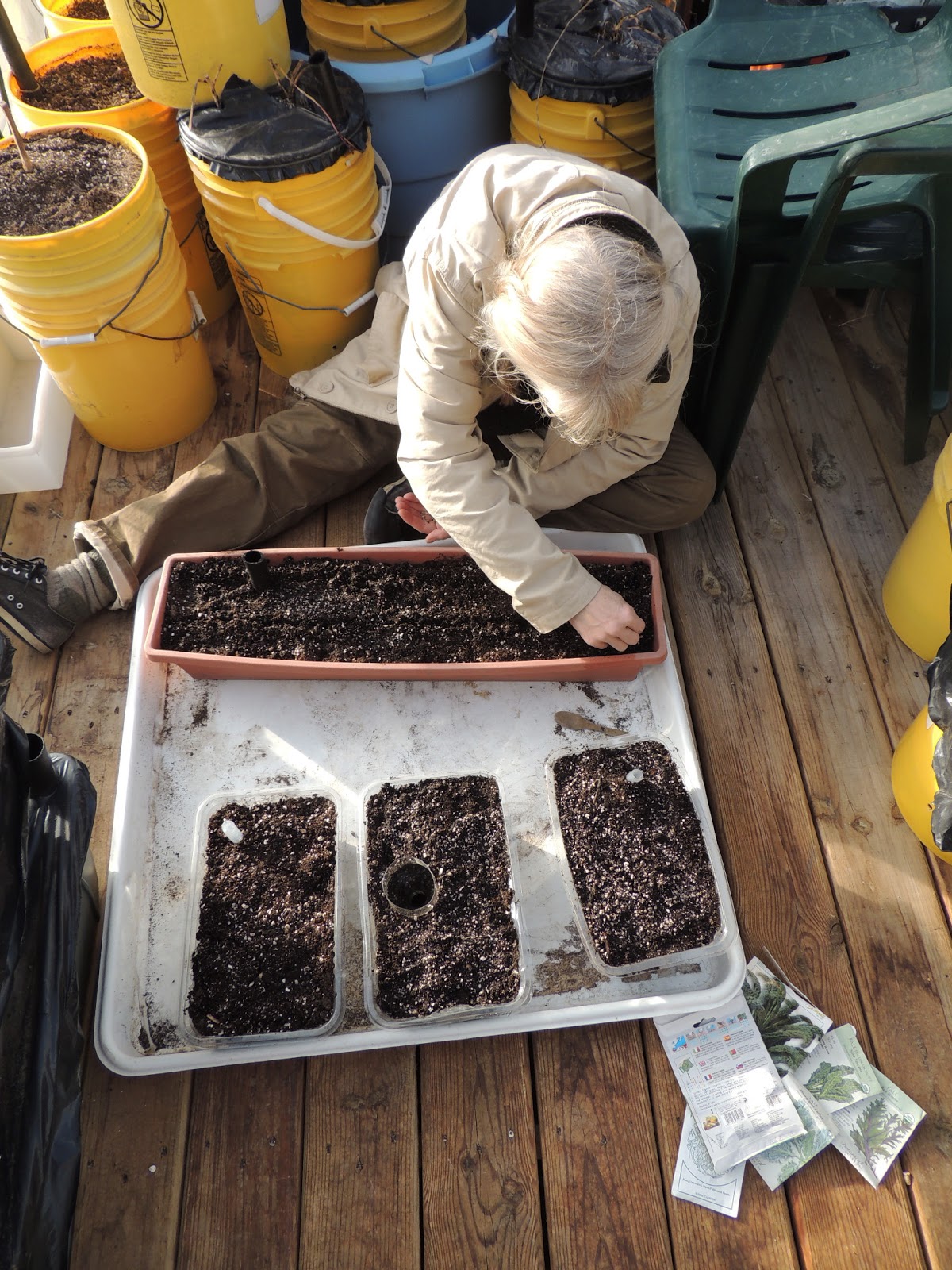
On Jan 9 I stepped out and sniffed the 50-degree+ Chicago air. Like an animalwaking from its winter slumber, I smelled the warm earth and immediately had the urge to plant something. So I located a few empty SIPs and washed them in hot vinegar water.
Happily, I have a friend on the roof to hoist up my planting boxes and watering can (no running water up there in winter, despite these occasional oddly warm temps).
The sun was shining as I opened the potting mix bin to reveal a couple of bags of peat, ready to be mixed with perlite this spring to create fresh potting mix.
I filled my small SIPs...and added a little balanced fertilizer.
Our growing roof is all tucked in for winter. Some of those yellow SIPs have even been washed and dried, stored now in the unheated greenhouse, which is where I'm heading.
I always have winter-spring seeds on hand, including some I ordered from Franchi late this fall.
Root Simple recently wrote about one of Franchi's gorgeous salad mixes, shown here growing in their LA garden. Eye-popping color.
Hey, I'm planting! This makes me happy.
We watered in the seeds lightly and covered the grouping with a plastic bag. As the greenhouse warms on sunny days, so too will the potting mix. During the single-digit cold coming this week, the mix will freeze, mimicking the in-ground environment.
When spring temperatures and increasing sun crack those seeds, they'll show some green, like these snap peas I planted in SIPs in the greenhouse in just the same way last winter. Here are their sturdy sprouts on March 11, 2012, when they were easily lifted and transplanted to one of our earthboxes. Check out the root development.
Why not plant peas or greens directly into a SIP? The greenhouse-trapped sun and heat prompts germination weeks earlier than otherwise on our roof. A head start on good eating.
The Baker Creek Heirloom Seed catalogue is one of my favorites. I await its arrival in the mail each year and then spend hours viewing the beautiful heirloom vegetables, fruits, herbs, and flowers. It’s amazing that these seeds come from more than 70 different countries!
Jere and Emilee Gettle, a 30-something couple, own and operate this unique seed company and are passionate about wanting to preserve heirloom seeds so that future generations can grow healthy, pure, nutritious food. When Jere was a child he took a strong interest in gardening. At 17 he launched his first seed catalog, consisting of 70 different seeds. Today his catalogue boasts more than 1300 varieties!
In 2010 Jere and his wife purchased Comstock, Ferre & Co. in Wethersfield, Connecticut, the oldest continuously operated seed company in the US, dating back to 1820. Here’s a great video of Jere discussing the seed industry, how he collects his heirloom seeds, and the history of Comstock, Ferre & Co.
Here are some Baker Creek tomatoes we’ve grown... beautiful and tasty too! This year I’m going to focus on letting Little Green Girl save her own seeds. I hope it will teach her how important it is to save heirloom seeds for future generations and also how plants grow, die, and give life again.
Chocolate Stripe
Orange Flesh Purple Smudge
Black Cherry
Violet Jasper
Lastly, here’s a great video on everything you wanted to know about seeds and more. Enjoy!
The GRGers met this week to thwart sub-zero temps by trading seeds and discussing the coming growing season. Debbie is clearly one of the weak-for-seeds brigade.
Check out her fine selection here, along with two tiny determinate tomato starts she gifted us with (we've never grown one--this will be fun), along with a pound cake (mmm). Up for sharing were long beans, melons, and myriad tomatoes.
While I made tea, she got to work sorting seeds while Bruce revealed his priorities by focusing on pound cake.
During our meet, Debbie told me about winter sowing. Can't believe I'd never heard of this technique, which mimics the action of the hearty volunteer seeds that come up in an in-ground garden each spring. For winter sowing, you plant cold-hearty seeds in a punctured covered container and set it outside, venting when the sun starts warming up the soil. Like planting in a cold frame or under a cloche, it makes good sense.
She pointed me to wintersown.org for the basics and I gathered some seeds we harvested last year and also some left over from the past several years.
Using the ubiquitous Earthbound Farm baby spinach containers (these are from years ago--I'd guess they never decompose), I put drain holes in the bottom and filled with a mix of moistened coir and compost we brought in last fall. Then I planted arugula, kale, mustard, tatsoi, baby bok choy, and beets.
Sprinkled with water, put on the covers, and used a carpet knife to cut air vents in the top.
Now they're in the backyard, ready for whatever mother nature brings. We'll crack them open to get some air when it warms up. And keep you posted on the outcome.
One reason I thought this would be fun is that Bruce is starting our cool-weather greens indoors today, under lights and in controlled warmth. The winter-sown seeds won't be ready in the four weeks his will be, but they should provide a succession of seedings for the roof and in-ground garden.
I walked to Bruce's today to drop off some chard seeds and visit his menagerie. Can you see Carl peeking over the chicken brooder? He gets a little jealous when a visitor's attention is drawn to peeping cheeping bits of fluff. It's fun to see their adult feathers emerging.
Bruce encouraged me to take a palm-full of feed and set my hand into the brooder. The chicks hopped right up--they're becoming nicely acclimated.
Carl is growing too. His paws seem a lot larger now that just a week ago. He's very smart, knowing when he's being naughty with his needle-sharp teeth but barely able to control his puppy self. Bruce is bringing a lot of tough love, a good thing since Carl may one day outweigh me.
Pasty butt--click for all the action. When a rear end dries out and plugs up, hands-on help is required.
Cheeping heartily during the procedure...
...and patiently getting dried off.
Carl loves the space heater that runs alongside the brooder.
I'm king of mountain (click to enlarge). Only in Chicago would 40 degrees F feel like spring.
Last year we did go on about Hudson Valley Seeds. Not only did their seeds grow strong and true for us here in Chicago, but the artist-produced packaging seems a perfect merging of beautiful regional vegetables and regional artists too.
Civil Eats just put up a nice interview with the proprietors, who say that choosing "artwork over photographs for our seeds packs...communicates what's important about seeds--that they come with stories."
Do they ever. Bruce started our greens seeds from Hudson Valley indoors early in 2010 and we planted out on St Patrick's Day. We particularly enjoyed the braising greens. Picked in their infancy, they provided endless salads (never did get around to braising them).
...and also the deep green tatsoi, shown here thriving on Bruce's roof.
Somehow I missed this October NYT story on Hudson Valley Seeds. On this wintry day you might enjoy thinking about the seed collection and packaging taking place there. We'll be renewing our membership this year. It's almost too good to be true: for $20, choose ten seed packs from about 130 heirloom varieties.
We let our tatsoi go to seed this summer, harvested it, and replanted this fall. It's thriving right now upstairs in our unheated (but not freezing) second floor. Art has since hung lights over this SIP line-up, and we'll return the lights to Bruce in a scant couple months so he can start the cycle of seed-starting all over again, getting our spring crop up to size for planting out in March.
For indoor growing this winter, we're using these commercially available SIPs, because the slow-growing indoor crop requires less potting medium and water than our two-bucket SIPs.
HVS is here. Click in the left-hand column to review seed types.
Summer 2010 was the antithesis of Summer 2009, the latter cool, rainy, and overcast. This year's Chicago growing season can best be described as a blast furnace. Could it be that we need to think about lightly shading plants to shield them from the sun?
Check out the black funk on these black velvet tomatoes. Click to enlarge. Seriously sad to cut down the plant, since it produced early and often this summer. We picked every one of the last beautiful fruits, which had no signs of disease. And then we removed the old fertilizer, added some new, and seeded the tomato SIP with collards. There, that's better. Our tomatoes started producing nearly two weeks early this year, but didn't have the stay power of other more moderate weather years.
I wonder if the heat stressed them so badly that it set them up for disease, because we surely have a lot of funky looking tomato foliage. Interestingly, I visited Bruce's roof garden (six blocks away) and his greenery is suffering from the same plant-destroying whatever. Further, my brother the in-ground organic gardener in suburban Chicago told me his heirloom tomatoes did not do well at all.
Still, there were some productive periods. I brought in a few pounds of produce every other day, enough to keep us happily fed (one of these years I'll start recording the weight like these folks do). The eggplant listada, from Seed Savers, was a robust producer, and nicely disease resistant. So was this Franchi tomato start from Debbie, a sort of Christmas tree loaded with flavorful small tomatoes. The Peppers Santa Fe Grande, another Seed Savers selection, always do well, and this year's heat didn't faze them. Here's a real downer. The Armenian cukes that Art built a new trellis for were devastated by powdery mildew, despite being planted in late June. One lonely cuke... This year we also planted summer squash in late June, trying to outwit the powdery mildew. I seeded some mustard alongside in one of our adopted earthboxes. But not so fast...click pic to see the powdery mildew in all its glory today (one nice squash too). We grew a melon called Golden Midget this year. I don't think the foliage is supposed to be golden though. Mildew again? Still, we got a beautiful melon, sweet as can be. Here's a pepper I planted very late--mid-July maybe--since it didn't get planted in May-June. I have no idea what it is (Bruce, any help?). Looks like a yellow banana type. This is planted in the Canadian SIP sold by our big-box Menard's store for $5. And here's a self-harvested Mickey Lee melon. I found it cracked on the roof on morning after it apparently cut loose from its vine on the melon trellis one windy night. Pried it open to reveal a gorgeous interior, sweet enough for dessert. You can always hope for more, better, and less disease, but this day's gathering looks bountiful. A fun upside to summer: Our new growing pals and co-bloggers Debbie and her Little Green Girl Kara visited the roof. Here Kara tries one of the purple tomatillos (or is she just faking it?). They generously brought us The World's Tiniest Tomato! (in addition to a bounty of others) from their garden. Debbie's heat-tolerant lettuce seeds are flourishing on the roof... And remember Brooke and Amy, who came this spring to learn about SIPs and help me try the new wicking fabric method? Their rooster spur peppers (left) loved this summer's extreme heat.
More good news: in September they'll be showing a group of children at the Fremont Public Library District, where they are librarians, how to make Bob Hyland's pop bottle planters. Each participant will plant a young lettuce plant and also direct-seed some of the cool-weather greens seeds saved from our roof. Way to go, you two! Most-fascinating-plant-to-grow-for-the-first-time award goes to...okra. Beautiful hibiscus-like flowers and noble fruit. This plant is about 7 feet tall. Remember the Olive Garden salad bowl SIP? This one's still growing salad, using seeds we harvested from plants started by Bruce in February, set out in March, and gone to seed last month. Nice mustard greens and wrinkled crinkled crumpled cress. We also direct-seeded some SIPs that had run their course. The tatsoi and collard seeds sprang to life, though it took several attempts because the heat on the roof dried out the soil the first few times. Growing food is filled with uncertainty: you can't control the weather or pests or spores that move invisibly on the breeze. There are ups, there are downs. On balance, though, it still seems remarkable that we can eat so well from the roof of a building in downtown Chicago. If the title of this post stumps you...listen: